
Adhering to Culturally and Linguistically Appropriate Services (CLAS) standards enables Riverside to best meet the needs of the diverse communities we serve and reinforces Riverside’s commitment to improving access to care in underserved communities. Culturally and linguistically appropriate services are fundamental to ensuring that everyone — regardless of background, language, or life experience — can access the care they need.
What are CLAS Standards?
CLAS standards are a set of recommended action steps intended to reduce health disparities and improve the quality of care for diverse populations. The standards were developed by the United States Department of Health and Human Services and adopted by the Massachusetts Department of Public Health to promote respectful, accessible, and non-discriminatory healthcare environments for everyone.
The Massachusetts Department of Public Health defines CLAS-compliant care as services that:
- Respect and respond to a client’s culture in a nonjudgmental and supportive manner
- Are affirming and humane, and rely on staffing patterns that match the needs and reflect the culture and language of the communities served
- Recognize the building of collaborative provider-client relationships between the provider and client, and seek to create a more equal field of interaction
- Consider each client as an individual, and do not make assumptions based on perceived or actual membership in any group
Think of CLAS standards like a pair of glasses that bring a blurred picture into sharp focus. When healthcare providers “put on their CLASes,” they have a clearer view of how to best support each individual with care tailored to their unique circumstances. Without these lenses, providers might miss crucial details about their patients’ cultural and linguistic needs.
Why are CLAS Standards Important?
Limited English proficiency, the prevalence of mental health stigma in communities of color, and other cultural barriers have been linked to adverse health outcomes. When someone misunderstands their medicine’s dosage, can’t accurately convey their symptoms, or has trouble accessing treatment altogether, the consequences can be serious.
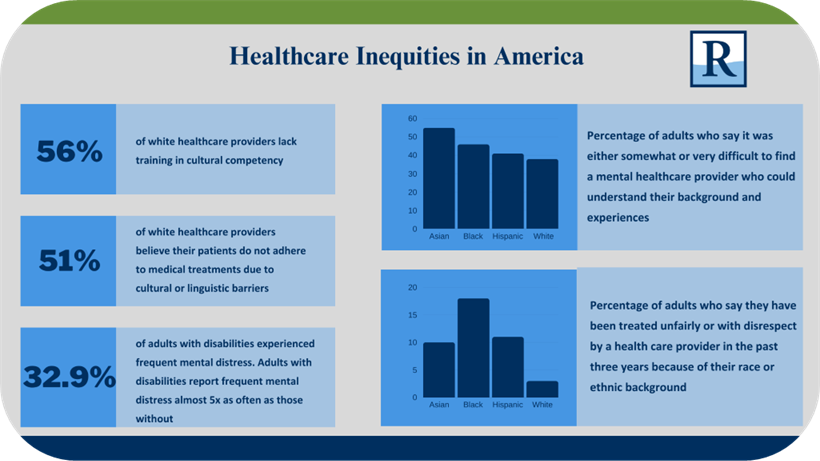
Providing CLAS-compliant care helps individuals reach optimal treatment outcomes by removing healthcare barriers stemming from differences in:
- Culture
- Religion
- Language Proficiency
- Health Literacy
- Disability Status
- Socioeconomic Standing
- Gender Identity
- And Sexual Orientation
For a detailed list of the specific CLAS standards, refer to the linked document.
Riverside’s Approach
CLAS standards include six main areas of action:
- Ensuring Language Access
- Reflecting and Respecting Diversity
- Fostering Cultural Competence
- Building Community Partnerships
- Collecting Diversity Data
- Benchmarking—Planning and Evaluating
While Riverside has made meaningful progress across all six areas, the organization determined that initially focusing on the following three categories would yield the most promising results.
Ensuring Language Access Via Enhanced Translation
Riverside has translated important forms, documents, and multimedia materials into a variety of languages, including Spanish, Portuguese, and Haitian Creole. Our partnership with the communications platform Lionbridge enables staff to quickly translate written content to over 350 languages, and by teaming up with the interpretation service Boostlingo, we can also provide timely interpretations across 300 languages — including American Sign Language. In 2025 alone, Riverside logged 2,593 interpreter requests through Boostlingo for over 660 hours of interpretation services. The most frequently requested languages were Spanish, Portuguese, Portuguese-Brazilian, Haitian Creole, and Mandarin Chinese.
Furthermore, Riverside’s CLAS Champions worked to obtain a “Right to an Interpreter” notice in 33 languages for programs within the organization. Prominently displaying this notice in reception areas allows individuals to simply point to their language of choice, and trained staff will set up the process for serving them, eliminating barriers and improving access to care.
Fostering Cultural Competence Through Comprehensive Trainings
Riverside has appointed CLAS champions to improve access to care through cultural competence and training. All staff have the opportunity to receive CLAS training, and employees who have completed it speak highly of the importance and effectiveness of these standards. Recently, a CLAS component was added to New Employee Orientation, and the topic is also integrated into Riverside’s Emerging Leaders program, ensuring that both incoming and developing staff understand how to best overcome barriers to equitable healthcare. Riverside’s CLAS foundation is strong: Over 550 employees have undergone CLAS training, and with new pathways in place, that number is set to keep rising.
Collecting Demographic Data to Improve Access to Care
Additionally, Riverside has prioritized collecting and analyzing demographic data across its programs to identify gaps in care and better understand service needs across the communities it serves. Capturing key demographic data empowers Riverside to make evidence-based decisions that will improve access to care and support service delivery.

Next Steps in CLAS Standards at Riverside
Riverside’s CLAS work is increasingly data-driven and goal-oriented. The organization has set three clear targets for 2026:
- Data completeness: Launch Continuous Quality Improvement (CQI) projects in the two divisions with the lowest rates of demographic data completeness, with a focus on better capturing who is being served
- Staff awareness: Reach at least 35% of staff through targeted trainings
- Accessibility: Develop and implement a standardized workflow and clear signage highlighting accessibility options for people served across 100% of Riverside’s programs by December 31, 2026
Tarshe Derival, Riverside’s Vice President of Culture & Belonging, powerfully conveyed the importance of CLAS standards. “Every person who walks through our doors deserves care that reflects who they are — their language, their culture, their life experience. CLAS standards are how we make that a reality.”
